36++ Completely Inelastic Collision Formula
Completely Inelastic Collision Formula. Learn more about inelastic collision in detail with notes, formulas, properties, uses of inelastic collision prepared by subject matter experts. C r is the coefficient of restitution;

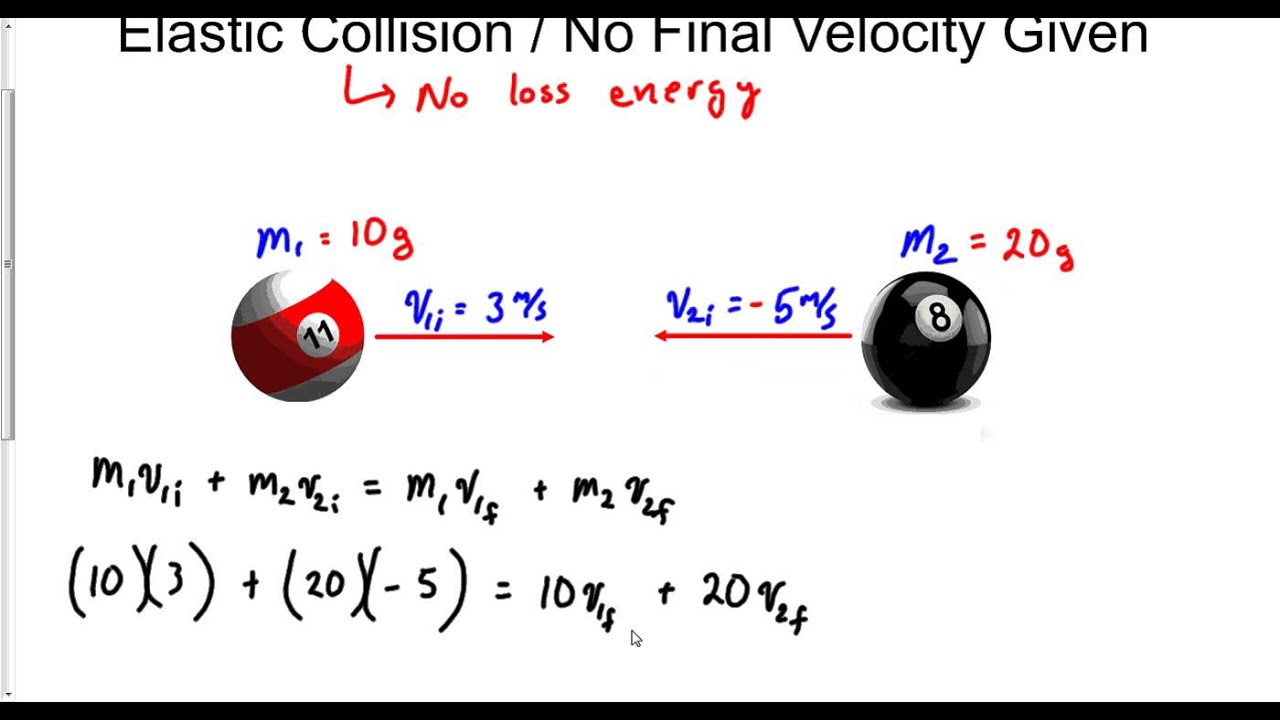
Physical sciences index classical mechanics index: It is represented by e and it depends upon the material of the colliding bodies. The perfectly elastic collision formula of momentum is followed as, m[{1}]u[{1}] + m[{2}]u[{2}] = m[{1}]v[{1}] + m[{2}]v[{2}] likewise, the conservation of the total kinetic energy is represented as,
corazones rotos imagenes compresseur dair pour voiture costume gris satine coffret cliquet 12
PPT Chapter 9 PowerPoint Presentation, free download
Mass of object 1 × initial velocity 1 + mass of object 1 × initial velocity 1 = (mass of 1 + mass of 2) × final velocity of combined objects) in. The perfectly elastic collision formula of momentum is followed as, m[{1}]u[{1}] + m[{2}]u[{2}] = m[{1}]v[{1}] + m[{2}]v[{2}] likewise, the conservation of the total kinetic energy is represented as, Kf / ki = m1 / ( m1 + m2 ) some basic mathematical analysis will allow you to look at the expression m1 / ( m1 + m2) and see that for any objects with mass, the denominator will be larger than the numerator. The elastic collision formula is given as m1u1 m2u2 m1v1 m2v2 10 12 8 4 10 v1 8 0 120 32 10 v1 0 152 10 v1 v1 152 ms for more such valuable equations and formulas stay tuned with byjus.

1 2 m v 2 + 1 2 m v 2 = m v 2. In a perfectly inelastic collision, two objects collide and stick together. So the value of the coefficient of restitution is zero in case of a perfectly inelastic collision. Collisions involve forces (there is a change in velocity). Elastic and inelastic collisions • energy is not.
Download a free pdf for inelastic collision to clear your doubts. 1 2 m v 2 + 1 2 m v 2 = m v 2. The initial velocity of body 2 = u 2. Before the collision a point object of mass m << m was sitting at the bottom of a frictionless spherical cavity of radius r embodied.

For a perfectly elastic collision, e = 1; This simplifies the equation to. The formula for inelastic collision: Finds mass or velocity after collision. An inelastic collision is any collision between objects in which some energy is lost.

The overall kinetic energy of the system internally is. If it is 0 we have a perfectly inelastic collision, see below. Physical sciences index classical mechanics index: Mass of body 2 = m 2. The perfectly elastic collision formula of momentum is followed as, m[{1}]u[{1}] + m[{2}]u[{2}] = m[{1}]v[{1}] + m[{2}]v[{2}] likewise, the conservation of the total kinetic energy is.
Mass of body 2 = m 2. The initial velocity of body 1 = u 1. Before the collision a point object of mass m << m was sitting at the bottom of a frictionless spherical cavity of radius r embodied inside the first car. If the kinetic energy changes then the collision is inelastic regardless of whether the objects.